


In August 1848, Sir Henry Edward Fox Young was appointed by Queen Victoria as the fifth and first civilian Governor. Fox Young earned a reputation as an accomplished and liberal colonial administrator through the emancipation of slaves in the British Caribbean.
The Governor Backs Goolwa Riverport
Governor Fox Young
Capital By The Murray Mouth
South Australia’s founders believed the capital should be close to the Murray Mouth as a base for river and ocean trade to support the new colony. Colonel Light was not impressed by the river mouth’s potential for navigation and chose the plain below Mount Lofty for the capital with the colony proclaimed on December 28 1836. A bitter dispute followed leading to the recall of Governor Hindmarsh in 1838.
In 1839 Governor Gawler explored the river and realised the mouth would need to be bypassed. Economic difficulties blocked action by Gawler and his successors, Grey and Robe for the next decade. Supporters of locating the capital near the river mouth pushed for development with Goolwa and Currency Creek surveyed in January 1840. The first land was sold by ballot in 1841 and by the early 1840’s the majority of land had been purchased in anticipation of a boom.
Governor Fox Young and Lady Augusta
In August 1848, Sir Henry Edward Fox Young was appointed by Queen Victoria as the fifth and first civilian Governor. Fox Young earned a reputation as an accomplished and liberal colonial administrator through the emancipation of slaves in the British Caribbean after the abolition of slavery in the British Empire in 1834.
Upon arrival Fox Young was confronted first by miners strikes at Burra and then economic disaster following the goldrush to Victoria in late 1851. In January 1852 he established the Gold Bullion Act bringing £1 Million of gold from Victoria for refining by the government and restoring confidence. Lady Augusta, Fox Young’s “spirited wife” was popular with a reputation as “a woman of wit”.
Fox Young with Lady Augusta explored the Murray by whaleboat from Wentworth to Goolwa and then overland to Port Elliot which convinced him to champion the river trade.

Lady Lady Augusta Sophia Young.Fox Young’s “spirited wife” was popular with a reputation as “a woman of wit”
Goolwa – Port Elliot – The First Public Railway in Australia
In June 1851, Fox Young secured permission from London to construct a horse-drawn railway linking Goolwa and Port Elliot.
This project marked the initiation of major public works in the colony, as essential materials like rails, turntables, and axles were acquired from London and shipped to Port Elliot. Construction began in 1851, starting with cuttings at both Goolwa and Port Elliot to lower the rail lines to sea level, establishing it as the oldest public railway undertaking in Australia. By 1852, work on the Goolwa Wharf commenced, accompanied by the construction of various public buildings. At both terminus points, facilities such as cranes, weighbridges, turntables, sidings, and horse stables were added. Large goods sheds were constructed at Goolwa Wharf, and a three-story shed was built at Port Elliot Jetty.
To protect Horseshoe Bay, a breakwater was necessary. Quarry work was done on the granite cliffs, and in 1853, a Beam Engine was imported to assist in placing massive blocks into position. By December 1853, cargo from paddle steamers at Goolwa began to be transferred to the partially completed railway line. The line was fully operational by May 18, 1854, marking it as the first public railway in Australia.
Creator:
Bodley Brothers
Description:
This beam engine was used in the construction of the Port Elliot breakwater and later for hauling vessels up on the Goolwa slipway. It has been restored to working order.
Date: c1849

The Governors River Race
In 1853 the Governor announced a prize of £4,000 for the first iron steamer to navigate the River Murray from Goolwa to Wentworth.
William Randell and Francis Cadell rose to the challenge with each building steamers. On August 25 1853 the Governor and his wife departed Goolwa aboard Cadell’s paddle steamer - the “Lady Augusta” They travelled 1,500 miles upriver to Gannawarra Station in Victoria returning with a barge full of wool bales, demonstrating the potential of the river trade.
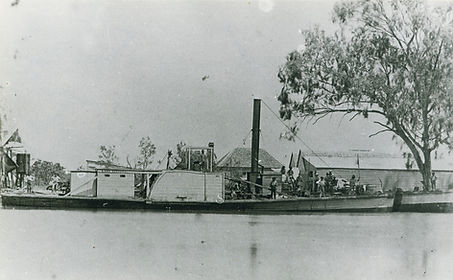
Side view of 'P.S. Lady Augusta' at Mannum, with crew and onlookers and sheds and buildings behind. 1864
Grand Harbour, Grand Canal or Railway
The need for a safe anchorage for ocean trade led Fox Young to consider alternatives. A grand harbour at the river mouth with a long breakwater was dismissed. A grand canal linking Goolwa to Victor Harbor was considered. Parliament passed an Act but funding was made the responsibility of the Council and the scheme lapsed.
Anxious to secure progress and reduce costs, Fox Young made the surprising decision to establish a harbour at Horseshoe Bay, Port Elliot. See the act for this.
Goolwa – Port Elliot – The First Public Railway in Australia
In June 1851 Fox Young obtained authority from London to build a horse-drawn railway from Goolwa to Port Elliot.
Construction marked the first major public works in the colony with rails, turntables, axles and other equipment purchased in London and shipped to Port Elliot. Work commenced in 1851 with cuttings made first at Goolwa and then Port Elliot to bring the rail lines down to sea level – the oldest public railway works in Australia. In 1852 construction of the Goolwa Wharf commenced followed by many public buildings. Cranes, weighbridges, turntables, sidings and horse stables were installed at each terminus. Large goods sheds were built at Goolwa Wharf with a 3-storey shed at Port Elliot Jetty.
A break water was needed to secure Horseshoe Bay. A quarry was cut into the granite cliffs and the Beam Engine was imported in 1853 to haul the huge blocks into place. By December 1853 cargo from paddle steamers at Goolwa was being transferred to the partly built line. On May 18 1854 the line was completed and in full operation – the first public railway in Australia.

The Goolwa-Port Elliot railway, from 1854, was the first railway in South Australia – and Australia’s first public iron railway, although it was horse-drawn, single track and only seven miles long.
Goolwa - The First Riverport in Australia
The establishment of Goolwa as a port began with decisions made by the Governor. Settlers flocked to the area, with Richard Ballard being the first boy born there on December 30, 1853, followed by Amelia Shetliffe, the first girl, on March 6, 1854. Goolwa was officially proclaimed Australia’s first Riverport on September 10, 1857.
Economic Boom
Fox Young's actions triggered an economic surge for the state and the South Coast, leading to the historic precincts we see today, a direct result of the Governor's support for Goolwa. In December 1854, Fox Young was transferred to Van Diemen’s Land, where he became the first Governor of Tasmania, marking a significant departure from the area's convict past.
“The past is not dead, it is living in us, and will be alive in the future generations.”
WILLIAM FAULKNER