


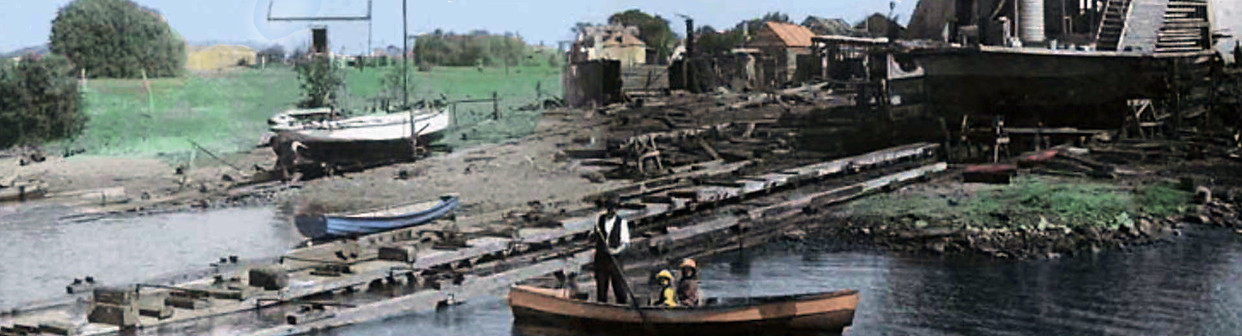
Captain Francis Cadell was instrumental in establishing shipbuilding in Goolwa. The Scottish sea captain sought the support of Governor Fox Young to launch a steamer service that would capture the river trade.
Shipbuilding at Goolwa River Port + Beam Engine
.jpeg)

Governor Sir Henry Fox Young
Captain Francis Cadell
Captain Francis Cadell
Born: 9 February 1822 Cockenzie, Haddingtonshir Scotland
Died: March 1879 (aged 57) near New Guinea
Nationality: Scottish
Occupation(s): Ship's Captain. Explorer, Blackbirder
Parent: Hew Francis Cadell (father)
Click to listen
Captain Francis Cadell was instrumental in establishing shipbuilding in Goolwa. The Scottish sea captain sought the support of Governor Fox Young to launch a steamer service that would capture the river trade. In September 1852, Cadell built a rough canoe called the *Forerunner* and successfully navigated the Murray River, arriving in Goolwa. He then ordered the *PS Lady Augusta*, named after the Governor's wife, to be built in Sydney, and it arrived in Goolwa in June 1853.On August 23, 1853, the barge *Eureka* was launched. This was the first riverboat constructed on the riverbank, built for Cadell by the Winsby Brothers. Designed to carry one hundred tons of cargo, the *Eureka*, towed by the *Lady Augusta*, became the first barge used on the River Murray, transporting the river's initial cargo of wool and skins.In 1855, the *PS Albury* and the *PS Gundagai* were imported in sections from Glasgow, Scotland. They were landed at Port Elliot and transported to Goolwa on the newly completed horse-drawn railway, where they were assembled on the riverbank for Cadell.
Cadell recruited skilled shipbuilders and captains from Scotland, providing housing near the wharf, which became known as Little Scotland. He ordered 13 of the first 15 riverboats built in Goolwa between 1853 and 1860, which included 11 barges and 2 paddle steamers. These were all constructed for The River Murray Steam Navigation Company, which pioneered river trade.
Click to listen
Shipbuilding and repairs emerged as the most significant industry in Goolwa, with shipyards along the riverbanks. Some shipyards operated simple slips where vessels were launched sideways into the river. The largest, the Goolwa Patent Slip, was established in 1852 and expanded in 1864 with the construction of the Goolwa Iron Works.

LAUNCH OF BARGE COBAR Built GoolwaComp Barge ,Length 99.9 ,Beam 20. 1 Hold 7 . 2 Adelaide, 1883 79,342 Goolwa, SA ... 1882 J. Wallace
The Patent Slip utilised a cradle powered by a steam-driven beam engine to raise and lower paddle steamers and barges. Goolwa was unique, as it was the only river port where entire steamers, equipped with locally cast engines, winch frames, and fittings, could be built.
From 1864 to 1885, the works employed between 30 to 40 men, with the foundry and smokestack becoming dominant features of the town's skyline. They designed, built, modified, and repaired more than 75 vessels. The most prominent shipbuilders included the Winsby Brothers, Hooker and Curson, Gordon, Shetliff, Graham, and Milne.
The peak of shipbuilding in Goolwa occurred from the 1850s to the 1870s, during which 45 riverboats were constructed.

1864: Side view of 'P.S. Lady Augusta' at Mannum, with crew and onlookers and sheds and buildings behind.
Introduction Of The Railways


Fireman loading firewood into the furnace
Engine Room PS Oscar W
Click to listen
The railway lines to Morgan in 1878 and Murray Bridge in 1885 led to a decline in river trade along the lower Murray during the 1880s. In 1888, the Goolwa Iron Works were sold to the Chaffey Brothers, along with the PS Bourke and three barges, which facilitated the foundry's relocation to Renmark.
During the late 1880s and 1890s, droughts and economic recession forced shipwrights in Goolwa to rely on repair and survey work to survive. During periods of low water levels, the entire Mannum fleet often came to Goolwa for repairs. Insurance companies required annual seaworthiness surveys, and as a result, Goolwa emerged as one of the principal survey ports, issuing 173 certificates in 1888 alone.
However, there was a resurgence in the early 1900s and up until the early 1910s, during which six more steamers and five barges were built, with three still in existence today.
In 1911, several notable vessels were constructed
-
The PS Industry, which can still be seen cruising in Renmark. -
-
The Barge Crowie, the largest barge on the Murray, built in Goolwa. -
-
The PS Kookaburra, the largest paddle steamer ever constructed in Goolwa.
In 1912, the PS Renmark was built; it sank in early 1951 and now lies submerged about 300 meters south of the wharf after burning down to the waterline following a day’s cruise to Point McLeay.
In 1913, the PS Canberra was the last paddle steamer built in Goolwa, and it can still be seen today cruising at Echuca. The following year, in 1914, the Barge Dart, the last riverboat built in Goolwa, was completed. The Dart returned to Goolwa and became part of the Signal Point Interpretive Centre. The Dart sank at Goolwa Wharf in 2008 and can be seen today resting under the Hindmarsh Island Bridge.
Craig was the last owner of the Patent Slip in the 1920’s with the last photo of repairs in 1925 marking the end of the heyday with the slip closed in 1932 after his death.
The heyday of shipbuilding lasted over 60 years. Between 1853 and 1914, 61 riverboats – 35 paddle steamers and 26 barges were built. With some 350 built along the Murray, Goolwa was the second-largest shipbuilding riverport after Echuca.
Goolwa Today
In the 1970s, large-scale shipbuilding was revived by Keith Veenstra and Jim Baker. In the 1980s, Tom Chapman established a new slipway on Hindmarsh Island, which was large enough to accommodate the PS Oscar for surveying. In the modern era, over 700 boats have been built, including 22 large vessels. Today, numerous businesses across Goolwa provide marine services and remain major employers in the area. Volunteers at Armfield Slip maintain wooden boats using traditional shipbuilding skills. Goolwa’s main street, Caddell Street, leads to the Goolwa Wharf, where the Chart Room, the Barge Dart, and Little Scotland are the only visible remnants of Goolwa’s shipbuilding heyday.
Tourism Links
2024 images of boat slips, boat sheds, and marine services, including Captain Sturt Marina, Goolwa Slipway, Coorong Quays, Goolwa Marine, and Burgar Boat. Highlights also include Little Scotland, the National Trust, Armfield Slip, and the Wooden Boat Festival.
Interesting Dates
Interesting dates, images and photos of Goolwa slips, construction and boat styles
-
1852 Goolwa Slip established by Winsby Brothers
-
1853 Beam Engine imported 1853 Port Elliot Breakwater then moved to slip in 1857
-
1864 Goolwa Iron Works established by Hooker and Curson
-
1867 Abraham Graham takes over Iron Works and Patent Slip
-
1866 PS Telegraph being built – showing Goolwa Wharf in background
-
1860 SS Wakool – first Screw Drive Steamer
-
1864 SW Maranoa - stern wheeler
-
1865 SW Lady Daly – largest vessel on the river
-
1866 TSS Goolwa – Twin Screw Steamer
-
1867 ?? – larger ferry built for Goolwa Council
-
1873 TSS Gertrude – Twin Screw Steamer
-
1874 TSS Napier - Twin Screw Steamer
-
1880 PS Grappler – conversion from snagging to dredge
-
1890 Caddell
-
1911 PS Industry – showing stages of build
-
-
Slipped, Flags, Repairs
-
-
-
1911 Barge Crowie – 290 ton – the largest barge built by David Milne
-
1911 PS Kookaburra – the largest paddle steamer built in Goolwa by David Milne – 141 feet
-
1912 PS Kelvin – original name plate on display
-
1912 PS Renmark – sunk off Goolwa Wharf 1951
-
1913 PS Canberra – last paddle steamer built
-
1914 Barge Dart – last barge built – AP newspaper reference
-
1920’s Last repairs in heyday - Captain Sturt, Tyro, Rob Roy on the Goolwa Patent Slip
-
1925 Last photo - P.S. William Davies on Craig's Slipway, 12 February 1925.
-
1930’s 1932 Craig died – slip work ended – Beam Engine moved to Caravan Park
-
1970’s Captain Sturt Marina - Veenstras Slip located on site – Curson Street Dart slipped after sinking
-
1980’s Tom Chapman established Coorong Qays with the new slip built to handle the PS Oscar W
-
-
Slipped every second year since 2007
-
-
-
2024 PS Oscar W and PS Marion slipped at Coorong Quays


The Bodley Brothers Beam Engine 1849


Living History
History of The Beam Engine
Situated at the mouth of the Murray River, Goolwa was established in the 1850s as South Australia’s first inland port. Without direct access to the open ocean, vessels were built and launched at Goolwa for navigating the Murray–Darling system. From 1853 to 1913, the town gained fame as the only place on the river system to build complete paddle steamers, including hulls, boilers, engines, and paddle wheels.
The Beam Engine and the Goolwa Slipway
One of Goolwa’s most notable artefacts is a Victorian-era beam engine, originally installed to haul vessels up the slipway at the historic shipyard.
The beam engine was made by Bodley Brothers around 1849. It first worked on the Port Elliot breakwater, hauling granite along the breakwater railway track. After completing this job, the engine was bought by the Winsby Brothers and, in 1857, installed on Goolwa’s slipway.
Its main role here was to lift riverboats out of the water for repair, maintenance, or building.

Port Elliot breakwater, hauling granite along the breakwater railway track 1887
Despite being rated at only 6 horsepower, the engine was essential. The Beam Engine operated on the slip until the death of its last owner, Richard Craig, in 1930. At that point, the slip stopped operating, and the engine was left forgotten.
In 1950, the Goolwa Progress Association rescued and restored the beam engine, which was then mounted at what is now Richard Ballard Park; it stayed there for nearly forty years.
Later, after an unsuccessful attempt to restore the engine in 1992, a feasibility study was carried out by the National Trust and the Alexandra Council to see if the engine could be saved. In 1997, the PS Oscar W moved the Beam engine to Cobdogla for restoration work by Denis Wasley from Australian Steam Power.
The A-Beam Engine and how does it work
The Basic Beam Engine

The A-type beam engine is a kind of steam engine where a pivoted overhead beam applies force from a vertical piston to a vertical connecting rod. This setup, with the engine directly powering a pump, was first used by Thomas Newcomen around 1705 to remove water from mines in Cornwall.
Engineer innovations, including James Watt’s addition of a separate condenser where added later. This modification was not implemented in the Bodley Brothers beam engine. Beam engines initially pumped water from mines or into canals but could also be used to boost water flow for waterwheels powering mills.
The cast-iron beam of the 1812 Boulton & Watt engine at Crofton Pumping Station is the oldest working example worldwide.
A Double-acting Piston Activated by a Slide Valve Cylinder.
Steam enters through the steam port SP and is admitted by the slide valve SV through the upper passage US to push down the piston P. Simultaneously, exhaust steam from below the piston passes back up the lower passage LS, via the valve cavity, to exhaust E. As the piston descends, the valve moves upward to admit steam below the piston and release exhaust from above.
The Beam engine of Goolwa
The Beam Engine That you see on Display
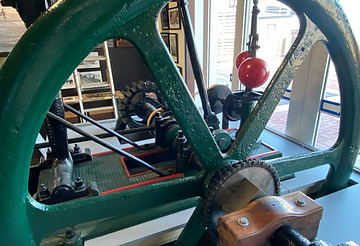
The Beam Engine on display is rotative, a later design in which the connecting rod drives a flywheel via a crank (or, historically, by a sun and planet gear). These engines could be used to directly power mill line shafts or steamships.
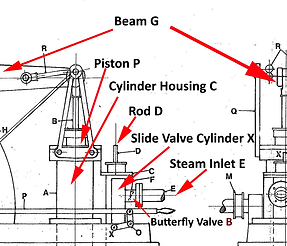
The inlet steam enters through a Butterfly valve B it is then managed via the slide valve X operated from rod D through a link (not shown). This rod, D, runs through beneath the base and connects to the governor, K, via bevel gears (not all shown). The governor K is driven by a belt from the crankshaft. The centrifugal force of the balls keeps the slide valve X under control, maintaining a set speed.
Steam enters the Cylinder Housing C. Inside the Housing, there is a vertical slide valve operated by Rod D. The valve alternately delivers steam to the top and bottom of the vertical piston P, making the piston double-acting and causing the beam G to move up and down in a reciprocating motion. This motion turns the crankshaft L into rotational power. Between each piston stroke, steam is exhausted via the slide valve through an outlet.
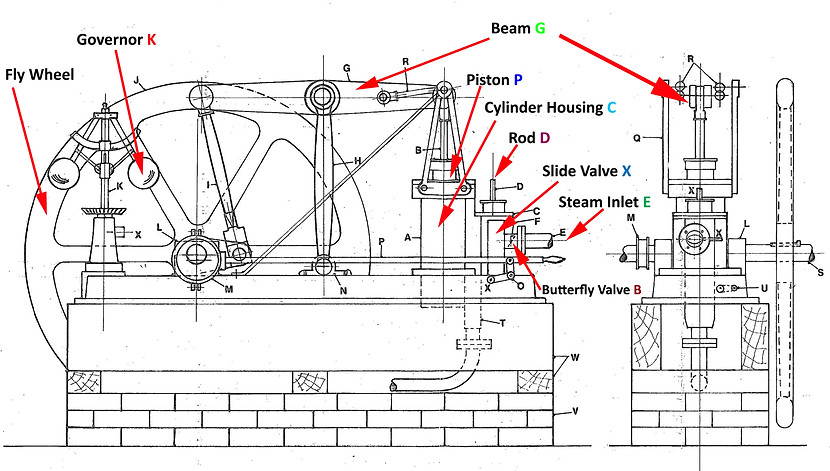
Technical Drawing of the The Bodley Brothers Beam Engine 1849
The engine was rated at 6 horsepower and delivered its power through a winch and reduction pulley system, the original of which can be viewed at the Goolwa National Trust Museum.The Beam Engine operated on the slip until the death of its last owner, Richard Craig, in 1930. At that point, the slip stopped operating, and the engine was left forgotten. In 1950, the Goolwa Progress Association rescued and restored the beam engine, which was then mounted at what is now Richard Ballard Park; it stayed there for nearly forty years.
Later, after an unsuccessful attempt to restore the engine in 1992, a feasibility study was carried out by the National Trust and the Alexandra Council to see if the engine could be saved. In 1997, the PS Oscar W moved the Beam engine to Cobdogla for restoration work by Denis Wasley from Australian Steam Power.
In 2025, as part of building the River Port Heritage Centre, the Friends of the PS Oscar W restored the beam engine, modifying it in the process to be driven by an electric motor. It now resides at the River Port Heritage Centre and is displayed for visitors to see, a living, working part of Golowa's heritage.


“The past is not dead, it is living in us, and will be alive in the future generations.”
WILLIAM FAULKNER